

Preventing Collisions at Sea, 1972, (COLREGS).
flange. If the gaskets are worn or deteriorated, replace
Statutory law requires naval compliance with the
them with new gaskets. Insert the globe and tighten the
International Rules of the Road. However, for ships
securing ring onto the base.
that cannot fully comply with the regulations with
respect to number, position, arc, or range of visibility of
NAVIGATION AND SIGNAL
these lights without interfering with the special
LIGHTS
construction or function of the ship, a certification of the
closest possible compliance with the regulations issued
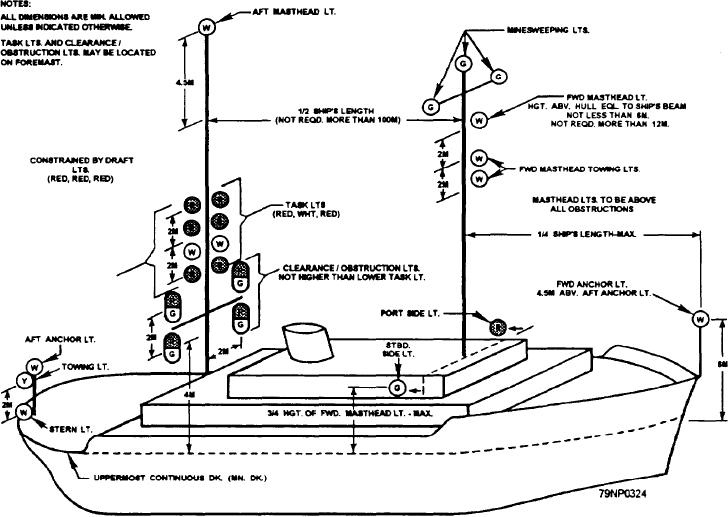
Navigation and signal lights include all external
by SECNAV is required. The certification requests are
lights used to reduce the possibility of collision and to
initiated by the Naval Sea Systems Command Figure
transmit intelligence. Figure 4-15 shows the general
4-16 illustrates the arcs of visibility for some of the
location of many of these lights aboard ship.
shipboard navigation running lights.
NAVIGATION LIGHTS
Presently, the U.S. Navy has two types of fixtures
in use for running lights (masthead, stern, and sick
The number, location, arc, and range of visibility of
lights) that are in compliance with the COLREGS.
the navigation lights, which must be displayed from
One type is the cast brass fixtures which use a
sunset to sunrise by all ships in international waters, are
cylindrical (open at both ends) Fresnel (corrugated) type
established by the International Regulations for
Figure 4-15.--General arrangement of lights for navigation.
4-16